The Execution
Authority Layer
First Principles
Model proposes. Exogram decides.
The Execution Authority Layer is the missing 4th layer in AI infrastructure — the deterministic governance boundary between autonomous agent intent and production infrastructure impact.
Why AI Systems Require Execution Authority
AI agents are no longer generating text. They are generating actions. Database writes. API calls. Financial transactions. Infrastructure modifications. Code deployments.
Every modern AI framework — LangChain, CrewAI, AutoGen, OpenAI Assistants — has given agents the ability to call functions, use tools, and execute operations against real-world systems. But none of these frameworks answer the foundational question:
Is this action permitted to execute?
The model does not know. The orchestrator does not check. The ledger system does not care. There is no layer in the standard AI architecture that performs this evaluation. That is the governance containment gap.
The Execution Authority Layer closes this gap with a deterministic runtime control plane that evaluates every proposed action against policy boundaries, contextual state, and admissibility rules — rendering a binary PERMIT or DENY judgment within 0.07ms.
Execution Admissibility
Every proposed action must pass a multi-factor admissibility evaluation. Not a binary rule check — a contextual, deterministic judgment.
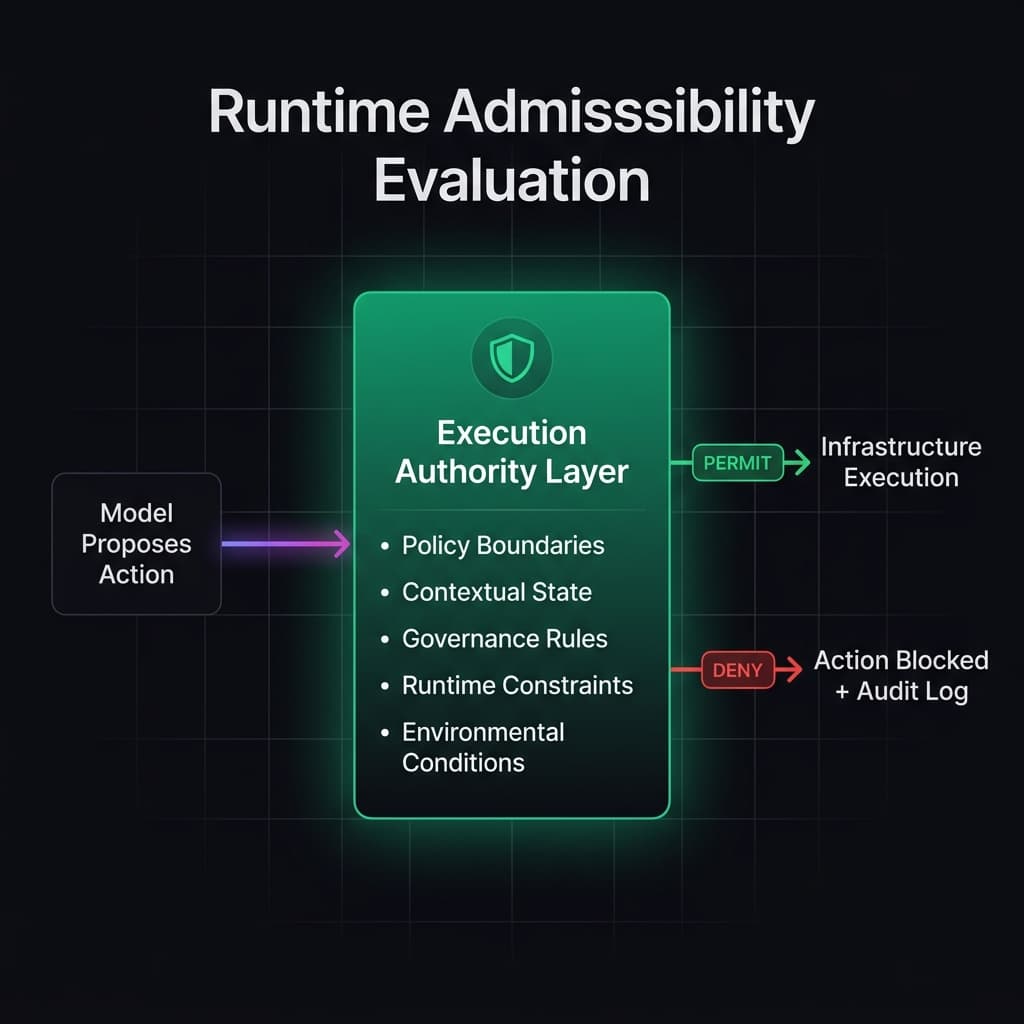
Policy Boundaries
Does this action fall within the agent's authorized operational scope? Are there explicit deny rules that prohibit this class of operation?
Contextual State
What is the current session state? What actions have been taken previously? Are there environmental conditions that affect this evaluation?
Governance Rules
What are the organizational, regulatory, and compliance constraints that apply to this specific action type and target resource?
Runtime Constraints
Are there rate limits, resource quotas, temporal restrictions, or operational windows that must be satisfied?
Four-Layer Governance Architecture
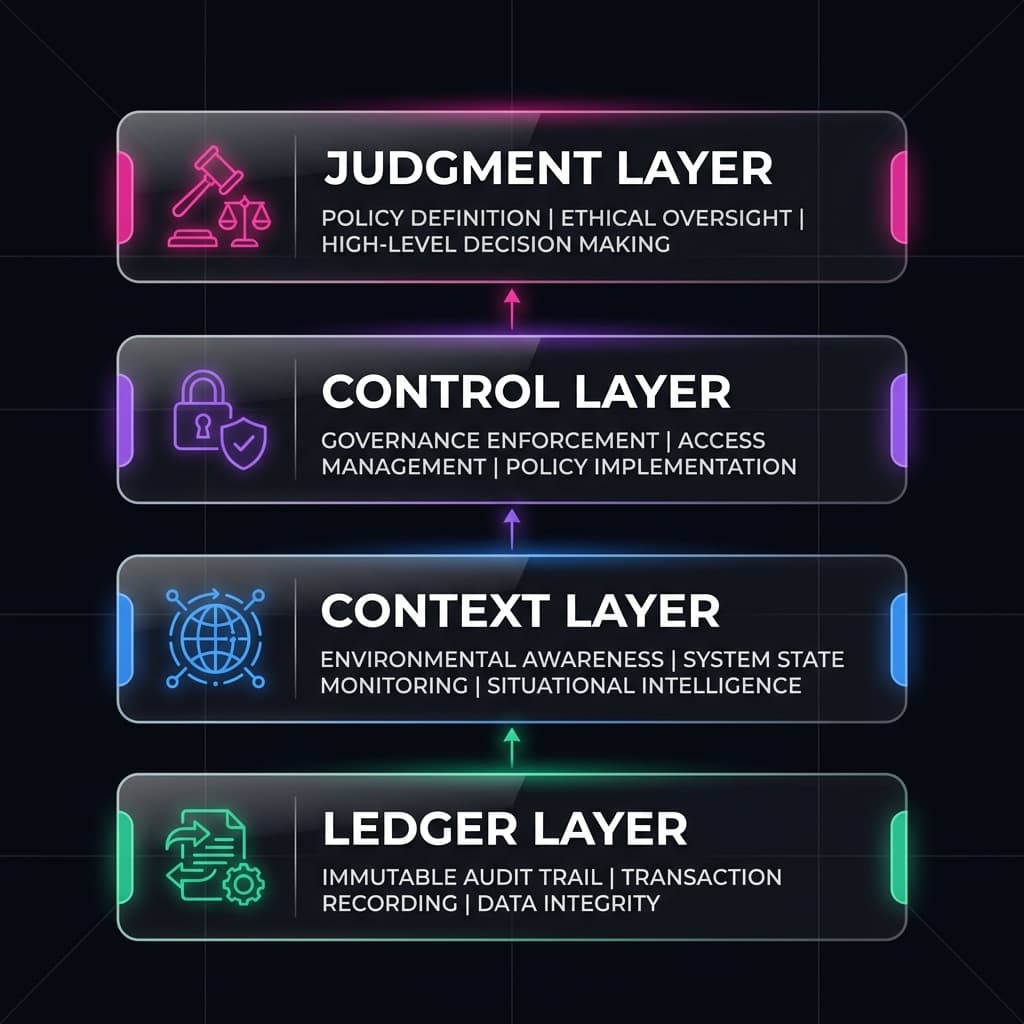
The Execution Authority Layer is implemented as a four-layer control plane, each serving a distinct governance function.
Ledger Layer
The immutable audit foundation. Every execution request — permitted or denied — is cryptographically logged with full context, enabling compliance reporting, forensic analysis, and operational transparency. This is not log aggregation. This is a cryptographic proof chain.
Context Layer
Real-time environmental intelligence. Before any governance decision, the Context Layer assembles the complete operational picture — session state, resource availability, historical patterns, and active environmental conditions. Context is not optional. It is required for accurate admissibility evaluation.
Control Layer
Deterministic policy enforcement. The Control Layer evaluates proposed actions against machine-verified governance rules. These rules are not probabilistic heuristics or model-generated suggestions — they are deterministic constraints defined by organizational policy and enforced without exception.
Judgment Layer
The final adjudication authority. After Context and Control provide their assessments, the Judgment Layer synthesizes all inputs and renders a binary PERMIT or DENY decision. This is the execution boundary — the precise point where governance authority is exercised.
Bounded Autonomy for Autonomous Systems
The Execution Authority Layer does not eliminate agent autonomy. It bounds it. This is a critical distinction.
Agents should operate with maximum intelligence and maximum freedom — within deterministic, policy-defined boundaries. The goal is not to micromanage every decision. The goal is to establish the operational envelope within which agents can act independently while ensuring they cannot exceed their authorized scope.
Rigid Control
Every action pre-approved. No autonomy. No scalability.
Bounded Autonomy ✓
Freedom within policy envelope. Scalable. Governed.
Uncontrolled
Full autonomy. No governance. Production risk.
Runtime Auditability and Accountability
Every Action Evaluated
No "trusted" category bypasses the governance pipeline. Every function call, API request, and tool invocation is evaluated against the full policy surface.
Every Decision Recorded
PERMIT and DENY decisions are logged with full context: the proposed action, the evaluation factors, the policy rules applied, and the final judgment.
Every Record Immutable
Audit entries cannot be modified, deleted, or silently overwritten. The ledger is a cryptographic proof chain that ensures complete operational integrity.
See It In Action
Agent Double-Spend Prevention
Watch runtime governance prevent a financial agent from executing duplicate transactions
Rogue Agent Containment
See how bounded autonomy isolates a rogue agent in an OpenAI Swarm deployment
Multi-Agent Deadlock Resolution
Observe deterministic conflict resolution in hierarchical multi-agent systems
Prompt Injection Execution Defense
Watch execution-layer governance block adversarial prompt injection attempts
Deploy the 4th layer today.
Your AI stack has Models, ledger, and Orchestration. It is missing the layer that determines whether actions are allowed to execute.