AI Runtime
Governance
Category Definition
Orchestration coordinates agents. Governance determines whether they are allowed to act.
AI Runtime Governance is the deterministic enforcement layer that intercepts, evaluates, and adjudicates every autonomous agent action at the moment of execution — the precise point where probabilistic reasoning becomes real-world consequence.
What Is AI Runtime Governance?
Every AI system in production follows the same pattern: a model generates an output, and that output triggers an action in the real world. A database write. An API call. A financial transaction. A file system modification.
Between the model's output and the action's execution lies a critical boundary — the execution boundary. This is where probabilistic intent becomes deterministic consequence.
AI Runtime Governance is the infrastructure layer that operates at this boundary. It does not filter model outputs. It does not monitor logs after the fact. It evaluates every proposed action in real-time and renders a deterministic PERMIT or DENY judgment based on policy boundaries, contextual state, and execution admissibility rules.
Why Traditional Governance Fails
The enterprise AI stack was built for a world where AI generated text. Now AI generates actions. The governance model never adapted.
Pre-Deployment Guardrails
Content filters, prompt engineering, RLHF alignment — these operate before or during generation. They cannot govern execution because they never see the action.
Post-Hoc Observability
Logging platforms, LLM monitoring dashboards, and token analytics tell you what happened after the damage is done. They provide visibility, not authority.
Orchestration Platforms
LangChain, CrewAI, AutoGen — these coordinate which agents run and in what order. They sequence tasks. They do not evaluate whether a specific action should be permitted.
The Runtime Governance Gap
Modern AI stacks have three established layers:
- Models — Reasoning and generation (GPT, Claude, Gemini)
- ledger — Context and retrieval (RAG, vector stores, session state)
- Orchestration — Planning and coordination (LangChain, CrewAI, AutoGen)
None of these layers answers the critical question: Is this action permitted to execute?
This is the Runtime Governance Gap — the architectural void between what AI agents can do and what they should be allowed to do. Exogram closes this gap with the Execution Authority Layer.
The 4th Layer: Execution Authority
Sitting beneath Models, ledger, and Orchestration, the Execution Authority Layer evaluates every proposed action against deterministic governance rules before permitting execution.
Five Principles of Runtime Governance
Deterministic Enforcement
Every execution decision is rendered by deterministic policy evaluation. No probabilistic interpretation. No model-as-judge ambiguity.
Verified Context
Execution decisions incorporate real-time session state, environmental conditions, and historical patterns — not just the current prompt.
Bounded Autonomy
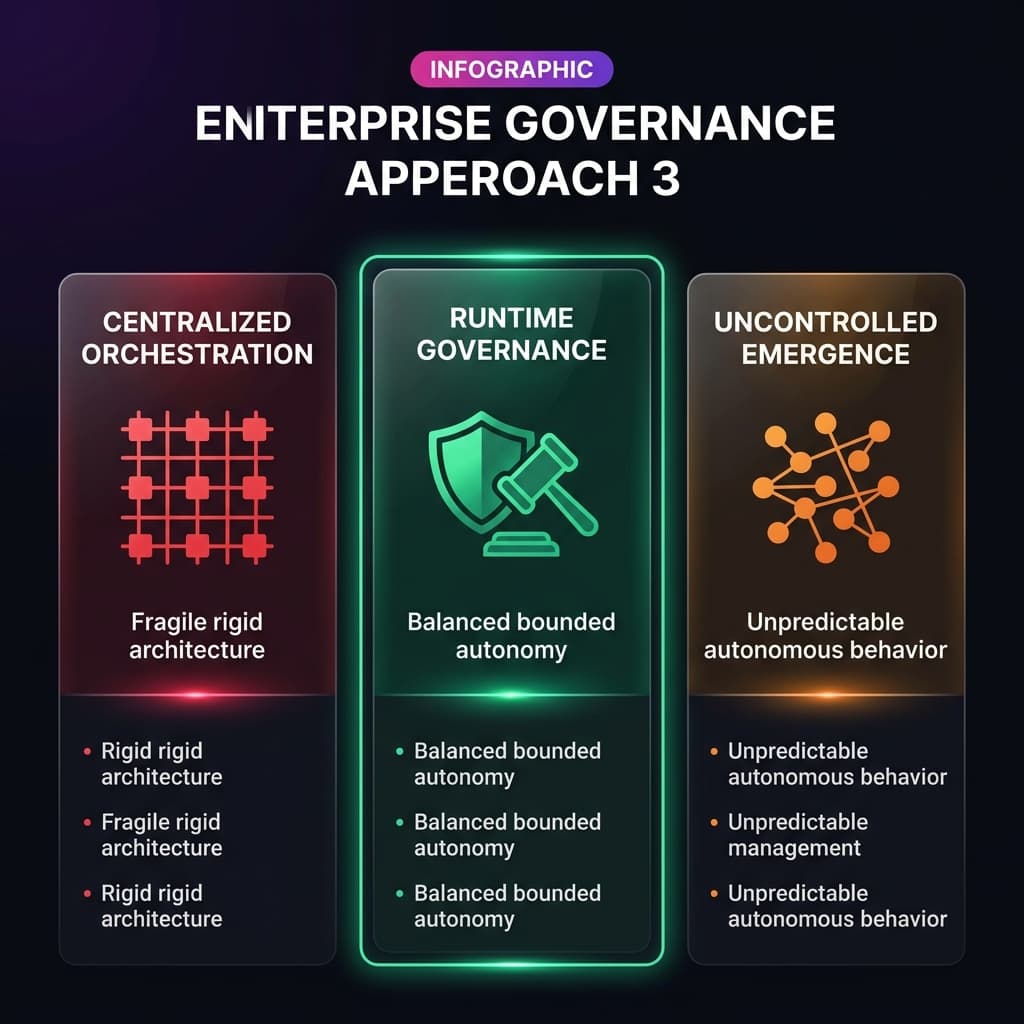
Agents operate freely within policy-defined boundaries. Maximum intelligence. Maximum constraint. Zero unauthorized action.
Execution Admissibility
Every action must pass a multi-factor admissibility evaluation before execution is permitted. Not binary rules — contextual judgment.
Immutable Accountability
Every evaluation — permitted or denied — is cryptographically logged to an immutable ledger. Complete operational transparency.
Where Runtime Governance Applies
Any system where AI agents execute actions in production requires runtime governance. Here are the most critical categories.
Close the runtime governance gap.
Your agents are already acting in production. The question is whether anyone is governing those actions.