Runtime Governance
Architecture
Not Orchestration
This is not a platform that coordinates agents. This is the authority that governs whether agents are permitted to act.
Exogram's Runtime Governance Architecture is a deterministic Authority Runtime that intercepts, evaluates, and adjudicates every AI agent action at the execution boundary — before it reaches production infrastructure.
The Runtime Flow
Every agent action passes through an 8-step deterministic pipeline. No exceptions. No shortcuts. No probabilistic bypass.
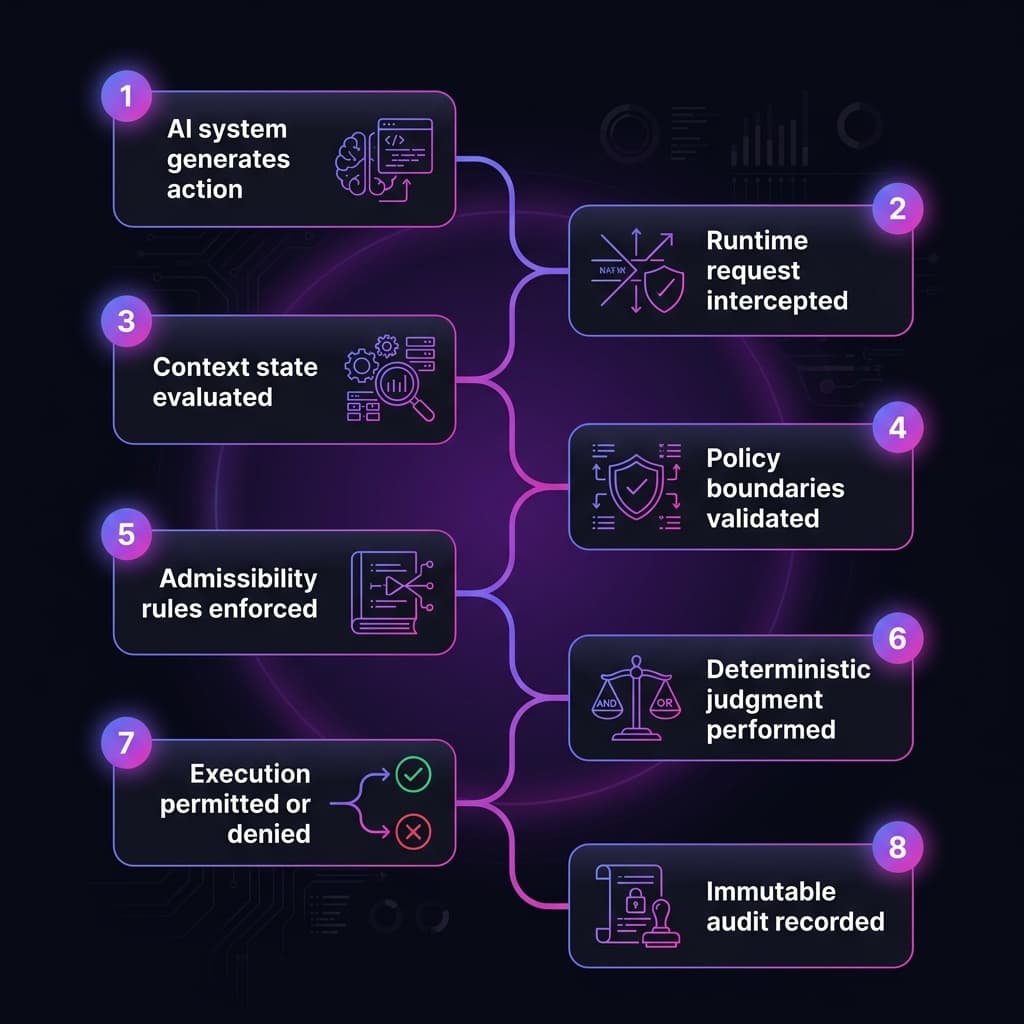
AI system generates action
An autonomous agent proposes an action via function call, API request, or tool invocation.
Runtime request intercepted
The action is intercepted by the Execution Authority Layer before reaching target infrastructure.
Context state evaluated
Current session state, historical patterns, and environmental conditions are assessed.
Policy boundaries validated
The action is evaluated against deterministic policy rules — no probabilistic interpretation.
Admissibility rules enforced
Execution admissibility criteria are applied: is this action permitted under current conditions?
Deterministic judgment rendered
A binary PERMIT or DENY decision is issued within 0.07ms. No ambiguity.
Execution permitted or denied
If PERMIT: action flows to infrastructure. If DENY: action is blocked and the agent is notified.
Immutable audit recorded
Every evaluation — permitted or denied — is logged to an immutable ledger for compliance and analysis.
Four-Layer Authority Runtime
Each layer serves a distinct function in the governance pipeline. Together, they form a complete deterministic runtime control surface.
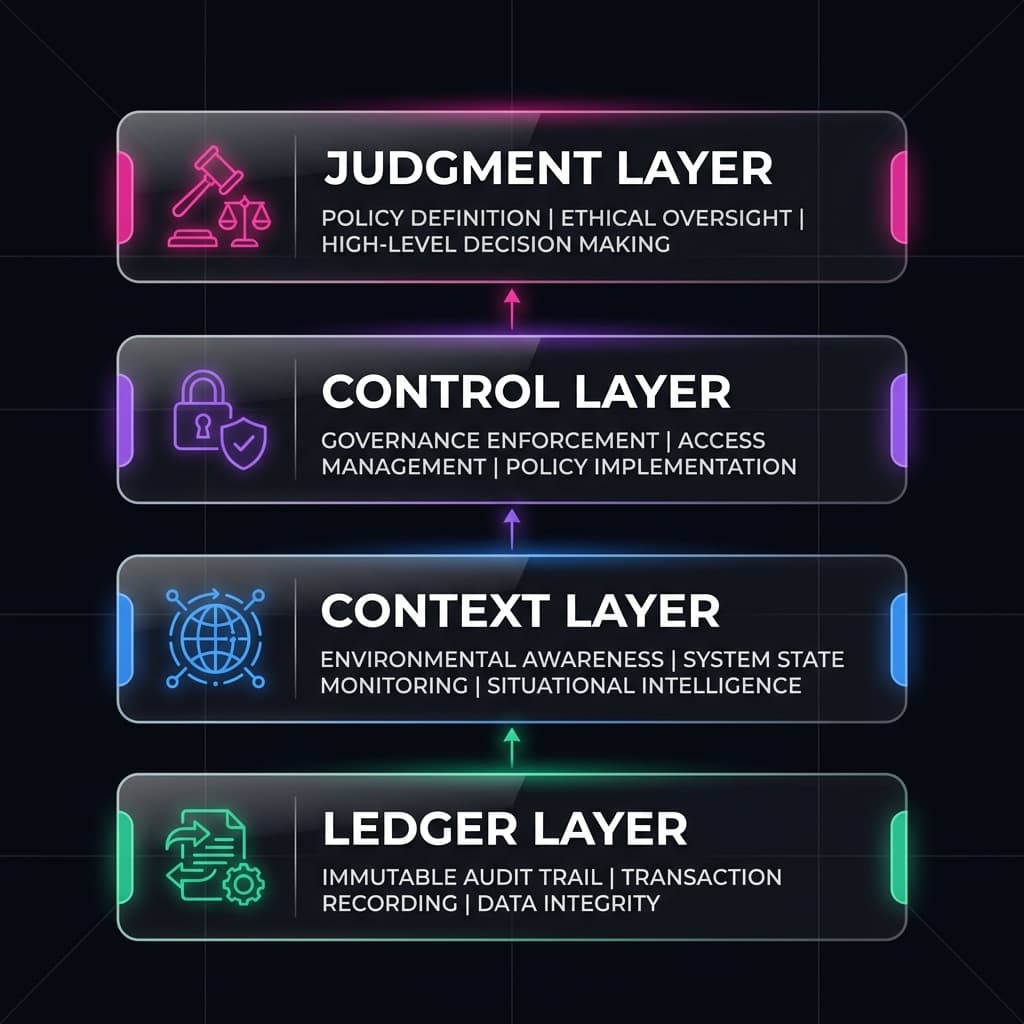
Ledger Layer
The immutable audit trail. Every execution request — permitted or denied — is cryptographically logged. This layer provides the foundational accountability infrastructure for compliance, forensics, and regulatory reporting.
- Immutable transaction logs
- Cryptographic integrity verification
- Compliance-grade audit trails
- Forensic replay capability
Context Layer
Real-time environmental state evaluation. Before any execution decision, the Context Layer assembles the current operational picture — session history, resource state, active policies, and environmental conditions.
- Session state tracking
- Resource availability assessment
- Historical pattern analysis
- Environmental condition monitoring
Control Layer
Policy boundary enforcement. The Control Layer evaluates proposed actions against deterministic governance rules. These are not probabilistic heuristics — they are machine-verified constraints.
- Deterministic policy evaluation
- Boundary constraint enforcement
- Resource scope limitation
- Action classification mapping
Judgment Layer
The final adjudication authority. After the Context and Control Layers provide their assessments, the Judgment Layer renders a binary PERMIT or DENY decision. Zero ambiguity. Zero override.
- Binary execution decisions
- Multi-factor admissibility scoring
- Conflict resolution arbitration
- Override-proof determinism
Bounded Autonomy: The Governance Principle
Runtime governance does not eliminate agent autonomy. It bounds it. Agents operate with maximum freedom within deterministic, policy-defined boundaries.
❌ Without Bounded Autonomy
- • Agents execute without constraint
- • No policy-aware decision boundary
- • Production incidents from uncontrolled actions
- • No audit trail for executed operations
✅ With Bounded Autonomy
- • Agents operate freely within policy envelope
- • Every action verified at execution boundary
- • Deterministic constraint enforcement
- • Complete immutable accountability
Traditional Guardrails vs. Runtime Governance
| Dimension | Traditional Guardrails | Exogram Runtime Governance |
|---|---|---|
| Enforcement Point | Model output layer | Execution boundary |
| Decision Logic | Probabilistic heuristics | Deterministic rules |
| Evaluation Speed | 100–500ms | 0.07ms |
| Bypass Resistance | Jailbreak-vulnerable | Override-proof |
| Contextual Awareness | Token-level | Full session + environmental state |
| Audit Granularity | Log aggregation | Immutable cryptographic ledger |
| Autonomy Model | Binary allow/block | Bounded autonomy with admissibility |
| Architecture Position | Wrapper around model | 4th infrastructure layer |
Architecture Philosophy
Governance is not observability.
Observability tells you what happened. Governance determines what is permitted to happen. These are categorically different functions with categorically different architectures.
The model does not get a vote.
Execution decisions are rendered by deterministic policy evaluation, not by asking the model if its own output is safe. LLM-as-a-judge is a probabilistic method evaluating probabilistic output. That is not governance.
Every action is adjudicated.
There is no "trusted" category of agent action that bypasses evaluation. Every function call, API request, and tool invocation passes through the full governance pipeline.
Accountability is non-negotiable.
Every evaluation — whether the action was permitted or denied — is recorded in an immutable ledger. No silent failures. No untracked exceptions. Complete operational transparency.
Deploy deterministic runtime governance today.
Stop relying on probabilistic guardrails. Start governing agent actions with a deterministic Authority Runtime built for production infrastructure.